
For thousands of Saskatchewan families living with epilepsy, hope just got closer to home.
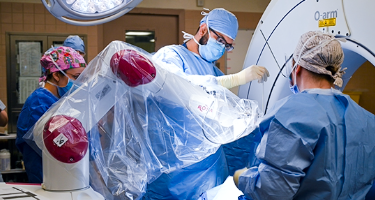
The first stereotactic robotic epilepsy surgery in Saskatchewan has been completed at Royal University Hospital, using the newly installed ROSA (Robotic Stereotactic Assistance) robot. Supporters from across the province raised $1.2 million to bring ROSA to RUH, inspired by a $700,000 lead gift from Merlis Belsher and his family. The robot is affectionately named Erin, in honour of Belsher’s granddaughter.
“We are so grateful to Merlis Belsher and Family for their inspiring matching gift and to all the donors from across Saskatchewan who stepped up to fund this technology,” says Jennifer Molloy, Chief Executive Officer of RUH Foundation. “It is incredible to see the impact of that generosity today.”
With ROSA, neurosurgeons can now place 16 to 22 electrodes in a single three-hour session with remarkable precision, dramatically reducing procedure time while increasing diagnostic capacity. After surgery, patients move to the Seizure Investigation Unit at RUH, where epileptologists monitor their seizure activity and create a precise map of where seizures take place in the brain. With that information, the team can determine the best next steps for treatment.
For the approximately 12,000 people living with epilepsy in Saskatchewan, and especially the 4,000 whose epilepsy has not responded to medication, this is a milestone. Until now, patients requiring this advanced diagnostic procedure had to travel out of province.
“The stereotactic robot is a key component of any centre offering comprehensive epilepsy care — and now it’s in use at RUH. With this new technology and the support and expertise of our epilepsy team, we can perform these important diagnostic procedures with greater efficiency and detail than ever before,” says Dr. Amit Persad, RUH neurosurgeon.
Your donations also supported Dr. Persad’s fellowship training at both Stanford University in California and Western University in London, Ontario, one of the highest-volume surgical epilepsy centres in North America. He is now teaching RUH neurosurgical residents how to use the robot.
“I have seen firsthand what this can mean for people: patients who went from daily seizures to finishing university degrees, starting careers, getting their driver’s licenses back. I am so proud to offer that level of care right here in Saskatchewan, and grateful for the support of the donors who made it possible,” he says.
Because of your generosity, Saskatchewan patients can now access world-class epilepsy care closer to home, closer to family, and right here at RUH.
-
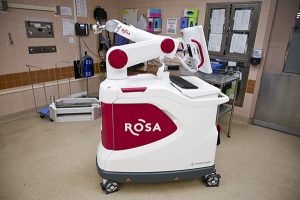
- The ROSA robot, “ERIN.”
-
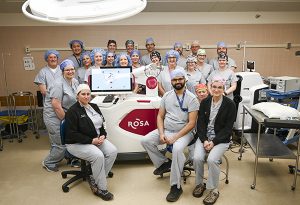
- The surgical team.
-
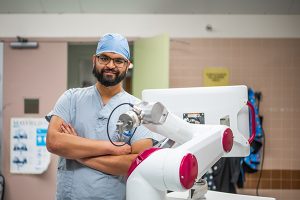
- Dr. Amit Persad.