The Long Wait
How a donor-funded robot named Erin helped one woman forge a path for Saskatchewan patients
Jacky Willmek spent 29 days in a hospital bed, hoping to have a seizure.
In March 2026, the 35-year-old pharmacy assistant originally from Beechy, Saskatchewan, became the first person in the province to have her brain mapped with ROSA, a donor-funded neurosurgical robot now in place at RUH.
To find out where her seizures began, Willmek’s care team first needed to see them happen. So, she placed her trust in Dr. Amit Persad and his team, who performed the landmark procedure, placing ten tiny electrodes deep in her brain.
“It’s surgery, but you can think of it as a fancy test. We map out exactly where in the brain we want to record from, and the robot places the electrodes there,” says Dr. Persad, a Stanford-trained neurosurgeon based at RUH.
Willmek’s seizures began suddenly in February 2022. She woke to find paramedics in her bedroom, with no memory of the episode they described. At first, she refused to go to the hospital. She had to go to work.
Epilepsy quickly reorganized the ordinary parts of her life. She lost her driver’s licence for close to two years, which meant long bus rides, Ubers and her partner Shawn timing his day around hers. Medication reduced the seizures without fully stopping them.
Through all of it, she held onto one core truth: “this is part of my life, but it doesn’t define me,” she says.
About 12,000 people in Saskatchewan live with epilepsy. For roughly a third, medication isn’t enough, and many could be helped by surgery once doctors know exactly where the seizures start. Until this year, finding that out meant leaving the province.
ROSA changed that. Named “Erin” in honour of donor Merlis Belsher’s granddaughter, the robot places as many as 22 electrodes deep in the brain in about three hours, where the older method placed three to five over a full day’s surgery.
The added precision gives the team a far clearer picture, and clearer options for patients who couldn’t be fully assessed before.
“It allows us to offer standard-of-care epilepsy surgery in Saskatchewan, and it gives us the capability to move beyond it,” says Dr. Persad.
This first surgery is a result of years of giving: the donor-funded Seizure Investigation Unit where Willmek was monitored, Dr. Persad’s fellowship funding that brought him back to Saskatchewan and the $1.2 million campaign that brought Erin to RUH.
To find Willmek’s seizures, the team needed to see them happen, so her medication was eased back to coax them out. Tethered to the wall and unable to leave the unit, Willmek spent day after day in bed, hoping for the one thing she’d been trying for years to avoid.
“Please have a seizure,” she said, her head wrapped in gauze and connected to the wall by wires. “I know it’s the only time I’ll say it, but please. Send seizure vibes.”
Her case turned out to be unique in more ways than one. In the months since the surgery, she hasn’t had another seizure. While the procedure was meant to map her epilepsy and guide her treatment plan, her doctors believe she may now be seizure-free. Dr. Persad is quick to say a result like hers is unusual and not what most patients should expect.
For Willmek, the procedure gave her something she’d waited years for: her regular life back. Now, she is hopeful for what will come next — not just for herself and her family, but for everyone else waiting for answers.
“I’m just interested to see how many more people they can help,” she says.
Read the full 2025–2026 Impact Report.
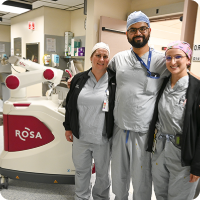
Neurosurgeon Dr. Amit Persad (centre) and the RUH team members pose with ROSA.
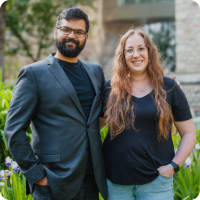
Dr. Amit Persad (left) with Jacky Willmek.
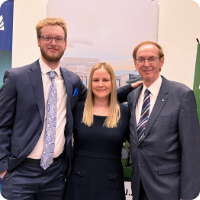
Merlis Belsher (right), with his son Patrick and granddaughter Erin, at the announcement of the $1.2 million fundraising campaign for the Neurosurgical Robotic System.
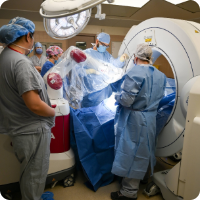
Neurosurgeon Dr. Amit Persad and the RUH team perform Saskatchewan’s first seizure robotic-assisted surgery on Jacky Willmek in March 2026.