No more 4 a.m. phone calls
How donor support fuels upgrades to advanced heart care in Saskatchewan
The text messages came at all hours. Four in the morning, the middle of a workday, the middle of the night. Every time Kara Fidelack’s phone lit up, she braced for it to be her daughter’s heart again.
From Regina, two and a half hours away, she couldn’t do much but answer. Caidence Fidelack, 21 and living on her own in Saskatoon would be phoning an ambulance by herself, her heart racing as high as 260 beats per minute. It happened nearly every month.
“She couldn’t even take a shower without feeling faint,” Kara says.
The episodes had started when Caidence was seven.
“Even as a kid, doing sports, I’d say my heart was beating really fast,” she says.
For years, tests turned up nothing.
It took persistence, and the keen eye of a cardiologist, before Caidence had her answer: Wolff-Parkinson-White syndrome, a condition that sends the heart into sudden, rapid rhythms.
With a diagnosis came a plan. At RUH, in the newly renovated Walter and Margaret McNabb Interventional Cardiology Suite, cardiac electrophysiologist Dr. Kelly Coverett and his team treated Caidence with a catheter ablation, a procedure she would undergo twice. The first attempt, in January, didn’t fully resolve her condition.
In May, the team went back in for a more extensive procedure.
The process went more smoothly than the family expected. There was room for Kara to be at her daughter’s side beforehand, and they were reassured by Dr. Coverett’s calm and thorough explanation of what was happening.
“It didn’t feel as scary as I thought it was going to be,” says Caidence.
“We knew about the new lab, and the technology that was upgraded,” added Kara. “That calmed my nerves a bit too.”
Donor support has long been key to ensuring RUH’s cardiology teams have access to the most advanced technology available, says Dr. Coverett.
“With ongoing updates and upgrades, we’re able to offer patients the most up-to-date arrhythmia management that they would find anywhere in the world,” he says.
Caidence is off medication now, her resting heart rate is lower, and the episodes have settled.\ She recently graduated from university, owns a business and is making plans for her next chapter.
“I feel a lot more at peace,” she says. “I can get back to my daily life.” She pauses on one idea. “I’m excited to be able to do a spin class.”
Read the full 2025–2026 Impact Report.
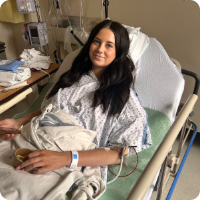
Cardiology patient Caidence Fidelak received two catheter ablation procedures at RUH.
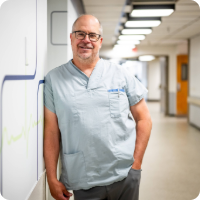
Dr. Kelly Coverett, cardiac electrophysiologist at RUH.